Tuesday, May 29, 2018

Credit Suisse maintains 'underperform' on Page Industries, despite PAT rising 41%

Textile and apparel manufacturer Page Industries on May 25�announced its earnings for the quarter ended March, reporting a 41 percent year-on-year jump in its net profit to Rs 94.2 crore.

The company's revenue rose 22.3 percent on year to Rs 608.4 crore. Its�operating profit or earnings before interest, tax, depreciation and amortisation (EBITDA) rose 51 percent to Rs�146.8 crore, while its EBITDA margin rose 450 bps to 24.1 percent.

Despite the seemingly positive set of numbers reported by the company, global research firm Credit Suisse has maintained an 'underperform' rating on the stock. However, it has raised its price target on it to Rs 21,300 from Rs 20,000 earlier.

The research firm said it continues to like the "structural story" of the company, driven by a gain in market share. However, it iterated that stock's valuation appears stretched.�Page Industries is�currently trading at 53�times its estimated earnings for FY20, with its growth nowhere near�its heyday of FY10-15.

At 12:00 hrs Page Industries was trading at Rs 24,307.25, down 0.65 percent, after touching an intraday high and low of Rs 25,199.95 and Rs 24,128, respectively.

Monday, May 28, 2018

Asia Stocks Set to Open Lower; Oil Extends Decline: Markets Wrap

Asian stocks are set for a lower start to the week after declines in U.S. shares Friday. The energy sector will be in focus after oil posted its biggest drop in roughly a year.

Futures in Japan, Australia and Hong Kong declined. U.S. stocks fell on lighter than normal volume Friday heading into the long Memorial Day holiday weekend though S&P 500 futures pointed to gains. The S&P 500 Energy Index plunged as oil slumped after a Saudi minister said that petroleum supply would likely rise in the second half. The dollar rallied and U.S. Treasury yields fell to the lowest in more than three weeks. The euro rebounded as political uncertainty continued in Italy.

#lazy-img-328086441:before{padding-top:56.25%;}

Investors turn their focus to the economy this week with the U.S. jobs report, the last before Federal Reserve policy makers meet in June, the highlight. Geopolitics also remains on traders minds with U.S. President Donald Trump appearing to confirm that his June summit with North Korea’s Kim Jong Un was back on, while Italy sank deeper into political uncertainty as populist leaders pulled the plug on their attempt to form a government.

Terminal users can read more in Bloomberg’s Markets Live blog.

These are some key events to watch this week:

U.S. markets are closed Monday for Memorial Day. U.K. markets are closed for the spring bank holiday.European Union foreign ministers meet in Brussels Monday to discuss developments related to North Korea, Yemen, and the Iran nuclear deal.EU trade chief Cecilia Malmstrom and U.S. Commerce Secretary Wilbur Ross are scheduled to meet Wednesday in an informal World Trade Organization ministerial in Paris.U.S. employment report for May due FridayOn Saturday U.S. Secretary of Commerce Wilbur Ross will travel to Beijing for more talks with Vice Premier Liu He on topics including ZTE Corp. and trade.

These are the main moves in markets:

StocksNikkei 225 Stock Average futures fell 0.3 percent in SingaporeS&P/ASX 200 Index futures fell 0.5 percent.Hang Seng Index futures fell 0.2 percent.Futures on the S&P 500 advanced 0.4 percent. The S&P 500 closed down 0.2 percent Friday, the Nasdaq 100 rose 0.2 percent.CurrenciesThe Bloomberg Dollar Spot Index was little changed after climbing 0.3 percent Friday.The Japanese yen sank 0.3 percent to 109.71 per dollar.The euro jumped 0.3 percent to $1.1681.BondsThe yield on 10-year Treasuries fell five basis points to 2.93 percent Friday.CommoditiesWest Texas Intermediate crude fell 1 percent to $67.21 a barrel after tumbling 4 percent on Friday.Gold lost 0.4 percent to $1,297.05 an ounce. LISTEN TO ARTICLE 2:56 Share Share on Facebook Post to Twitter Send as an Email Print

Sunday, May 27, 2018

Italy May Be Cut by Moody's on Concerns Over New Government

Italy’s rating may be cut by Moody’s over concerns about the new government’s fiscal plans and the risk that some important past measures, such as pension reform, might be reversed.

While "some of the coalition parties’ original proposals have been modified in the final coalition agreement, they would still lead to a weaker, not a stronger, fiscal position going forward," the agency said in a statement Friday. "So far, Moody’s has assumed a gradual deficit reduction over the coming years, which in turn would allow for a very gradual decline in the public debt ratio."

Italy’s public debt stood at 2.3 trillion euros at the end of March, according to the nation’s central bank. With the second-biggest public-debt ratio in the euro zone, pledges by the new government of increased spending have unsettled financial markets. The Italy-Germany 10-year yield spread reached the widest since 2014 earlier Friday.

"Far from offering the prospect of further fiscal consolidation, the ’contract’ for government signed by the two parties includes potentially costly tax and spending measures, without any clear proposals on how to fund those," Moody’s said.

Italy is currently rated Baa2 by the agency, the second-lowest investment-grade rating.

The Five Star Movement and League party have published a coalition government plan that includes reviewing fiscal policy, bail-in rules and Basel banking accords. Italy Premier-Designate Giuseppe Conte said Thursday that protecting savers hit by bank failures is a priority and "those who have suffered fraud or have been deceived will be refunded." Analysts and investors worry that the measures could slow the reduction of bad debt and hit banks’ valuations.

LISTEN TO ARTICLE 1:35 Share Share on Facebook Post to Twitter Send as an Email Print

Saturday, May 26, 2018

California Says PG&E Power Lines Caused 4 of October's Fires

PG&E Corp.’s equipment was responsible for causing four of the wildfires that tore through Northern California in October, investigators from the state’s Department of Forestry and Fire Protection determined in a report Friday.

The fires in Butte and Nevada counties were caused by trees or branches coming into contact with PG&E power lines, according to a statement citing results of the first investigations into the fires last year. The causes of the larger wine country fires, including the Tubbs Fire, weren’t disclosed.

The investor-owned utility owner has lost more than $12 billion in market value since the wildfires broke out. It suspended its dividend and withheld its 2018 profit guidance because of uncertainty about how much it might have to pay for damages. The fires in Napa and Sonoma counties were some of the worst in state history, destroying thousands of structures and killed 44 people.

Under California law, utilities can be held liable for costs if their equipment is found to have caused a fire -- even if they followed safety rules -- based on a legal principle known as “inverse condemnation.” PG&E Chief Executive Officer Geisha Williams has called the policy “deeply flawed.” The company, along with California’s other investor-owned utilities, has been lobbying the state’s lawmakers and regulators to change it.

California Governor Jerry Brown said in March that he will work with state leaders to develop policies this year to update wildfire liability rules and regulations for utilities. Brown has said the state is at higher risk for more severe and frequent fires due to climate change.

Insured losses claimed from the Northern California wildfires totaled $9.55 billion as of the end of January, the state insurance agency said.

LISTEN TO ARTICLE 1:43 Share Share on Facebook Post to Twitter Send as an Email Print

Friday, May 25, 2018

State of New Jersey Common Pension Fund D Buys 86,400 Shares of Golar LNG Partners LP (GMLP)

State of New Jersey Common Pension Fund D boosted its stake in shares of Golar LNG Partners LP (NASDAQ:GMLP) by 126.3% during the first quarter, Holdings Channel reports. The institutional investor owned 154,800 shares of the shipping company’s stock after purchasing an additional 86,400 shares during the quarter. State of New Jersey Common Pension Fund D’s holdings in Golar LNG Partners were worth $2,649,000 at the end of the most recent quarter.

A number of other hedge funds and other institutional investors also recently added to or reduced their stakes in GMLP. SeaCrest Wealth Management LLC acquired a new position in Golar LNG Partners during the fourth quarter worth $107,000. M&T Bank Corp acquired a new position in Golar LNG Partners during the fourth quarter worth $927,000. California Public Employees Retirement System boosted its stake in Golar LNG Partners by 1.8% during the fourth quarter. California Public Employees Retirement System now owns 154,810 shares of the shipping company’s stock worth $3,530,000 after buying an additional 2,679 shares during the last quarter. Cetera Advisors LLC acquired a new position in Golar LNG Partners during the fourth quarter worth $201,000. Finally, First Trust Advisors LP boosted its stake in Golar LNG Partners by 16.5% during the fourth quarter. First Trust Advisors LP now owns 464,238 shares of the shipping company’s stock worth $10,585,000 after buying an additional 65,759 shares during the last quarter. 42.13% of the stock is currently owned by institutional investors.

Get Golar LNG Partners alerts:

Shares of Golar LNG Partners stock opened at $20.69 on Thursday. Golar LNG Partners LP has a 52 week low of $16.78 and a 52 week high of $23.46. The firm has a market capitalization of $1.44 billion, a PE ratio of 11.01, a price-to-earnings-growth ratio of 2.21 and a beta of 0.89. The company has a current ratio of 1.73, a quick ratio of 1.71 and a debt-to-equity ratio of 1.93.

Golar LNG Partners (NASDAQ:GMLP) last announced its quarterly earnings results on Wednesday, February 28th. The shipping company reported $0.37 EPS for the quarter, beating the Thomson Reuters’ consensus estimate of $0.27 by $0.10. Golar LNG Partners had a return on equity of 17.99% and a net margin of 29.85%. The business had revenue of $90.11 million for the quarter, compared to analyst estimates of $87.09 million. equities analysts forecast that Golar LNG Partners LP will post 1.16 earnings per share for the current fiscal year.

The firm also recently declared a quarterly dividend, which was paid on Monday, May 14th. Stockholders of record on Monday, May 7th were paid a $0.5775 dividend. This represents a $2.31 annualized dividend and a dividend yield of 11.16%. The ex-dividend date was Friday, May 4th. Golar LNG Partners’s dividend payout ratio (DPR) is presently 122.87%.

Golar LNG Partners announced that its board has initiated a stock buyback plan on Monday, March 5th that permits the company to repurchase $25.00 million in outstanding shares. This repurchase authorization permits the shipping company to reacquire shares of its stock through open market purchases. Stock repurchase plans are often a sign that the company’s management believes its shares are undervalued.

A number of equities analysts have weighed in on GMLP shares. Seaport Global Securities reissued a “hold” rating and set a $21.00 price objective on shares of Golar LNG Partners in a research note on Tuesday, February 27th. BidaskClub raised Golar LNG Partners from a “sell” rating to a “hold” rating in a research note on Wednesday, May 2nd. B. Riley began coverage on Golar LNG Partners in a research note on Thursday, May 17th. They issued a “hold” rating and a $23.00 price target on the stock. Zacks Investment Research lowered Golar LNG Partners from a “hold” rating to a “sell” rating in a research note on Thursday, March 1st. Finally, ValuEngine lowered Golar LNG Partners from a “buy” rating to a “hold” rating in a research note on Friday, February 2nd. Six research analysts have rated the stock with a hold rating and four have assigned a buy rating to the stock. Golar LNG Partners presently has a consensus rating of “Hold” and an average price target of $23.50.

Golar LNG Partners Company Profile

Golar LNG Partners LP owns and operates floating storage regasification units (FSRUs), liquefied natural gas (LNG) carriers, and floating liquefied natural gas vessel industries under long-term charters in Brazil, the United Arab Emirates, Indonesia, Jordan, and Kuwait. The company also engages in the leasing of its fleets.

Want to see what other hedge funds are holding GMLP? Visit HoldingsChannel.com to get the latest 13F filings and insider trades for Golar LNG Partners LP (NASDAQ:GMLP).

Institutional Ownership by Quarter for Golar LNG Partners (NASDAQ:GMLP)

Thursday, May 24, 2018

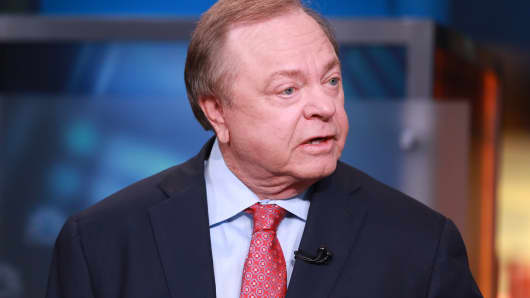
Oil may be headed to $80 next, says drilling pioneer Harold Hamm

Oil prices still have room to run after rallying to 3陆-year highs, drilling pioneer Harold Hamm said Wednesday.

The Continental Resources chairman and CEO said benchmark U.S. crude prices could still rise by about $10 from current levels near $72 a barrel.

"We're not looking at $100 oil in the future, or probably $90 oil, but it certainly could be in the mid-$70s and low $80s," he told CNBC in an interview on the sidelines of the Williston Basin Petroleum Conference in Bismarck, North Dakota.

Continental, one of the so-called frackers that pioneered drilling in North Dakota's Bakken shale fields, is getting an extra boost from higher prices. According to Hamm, the company did not hedge its production. Hedging, or locking in a price with buyers for future oil deliveries, protects drillers against price drops, but the practice can also leave money on the table if the cost of crude rises significantly.

Harold Hamm David Orrell | CNBC Harold Hamm

Shares of Continental are up 60 percent over the last 12 months, and 26 percent this year. Meanwhile, the XOP, a closely followed ETF that tracks oil and gas exploration and production stocks, is up nearly 22 percent over the last year and almost 16 percent year to date.

At current prices, Hamm said Continental could generate $1 billion in free cash flow, which the company will use to reduce its debt load following a prolonged period of low crude prices. Producers like Continental rely on expensive drilling methods like hydraulic fracturing and horizontal drilling to squeeze oil and natural gas from shale rock formations.

Continental ended the first quarter of 2018 with $6.17 billion in debt. Hamm said the company's goal is to get that down to $5 billion.

That dovetails with the dominant trend in the relatively young shale fracking industry: exercising financial discipline in order to start returning more cash to shareholders.

Shale drilling has boosted U.S. crude production to record highs, but surging output in West Texas has led to bottlenecks because the region doesn't have enough pipelines to handle the new supply. That's an issue North Dakota has largely overcome, said Hamm.

"We had that up here, as you'll recall, and certainly before we got adequate pipelines and gathering," said Hamm. "But now that we have it, our cost structure is much lower, and they still have headwinds in that area."

"We saw a differential change of three-and-a-half dollars when [the Dakota Access Pipeline] came on. That was huge and made it easier getting that to market," he said.

The Dakota Access Pipeline began carrying crude from North Dakota to Illinois last year after President Donald Trump cleared a path for the pipeline, which spurred protests by Native American tribes and environmentalists that drew national attention.

Wednesday, May 23, 2018

Eiger BioPharmaceuticals: Elucidating The Fundamentals Powering A Big Winner


Entrepreneurs are great at dealing with uncertainty and also very good at minimizing risk. That's the classic great entrepreneur. - Value Investor (Mohnish Pabrai)

Eiger BioPharmaceuticals (NASDAQ:EIGR) is experiencing a robust bull run for the day. This company is harnessing the innovative power of its team to brew an interesting drug portfolio that can deliver hopes for patients suffering from rare genetic diseases. As alluded, the stock was catapulted $4.77 higher at $16.62 for over 40% profits. The substantial profits were due to the latest partnership development with Merck (NYSE:MRK) that we��ll discuss later. In this research, we��ll elucidate pertinent corporate fundamentals and the latest partnership catalyst for the lead molecule (Lonafarnib).
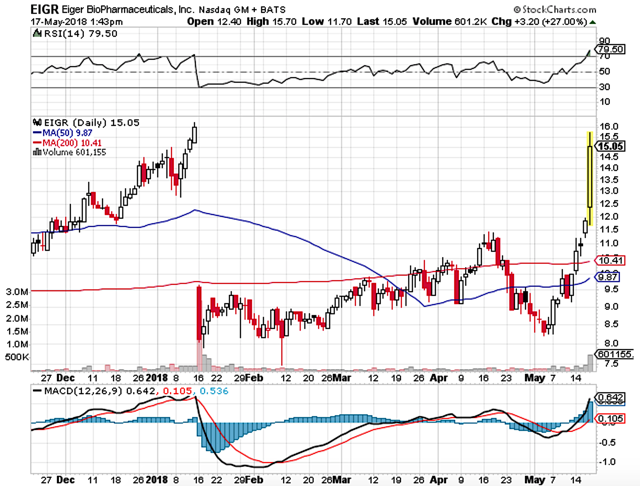
Figure 1: Eiger stock chart. (Source: StockCharts).

Fundamentals Analysis

Based in Palo Alto, CA, Eiger is focusing on the innovation and commercialization of medicines to treat rare and highly difficult-to-manage conditions. Lead by a management team having the extensive clinical and commercial expertise, the company is powering an enriched portfolio of novel advanced-stage molecules as shown in figure 2.
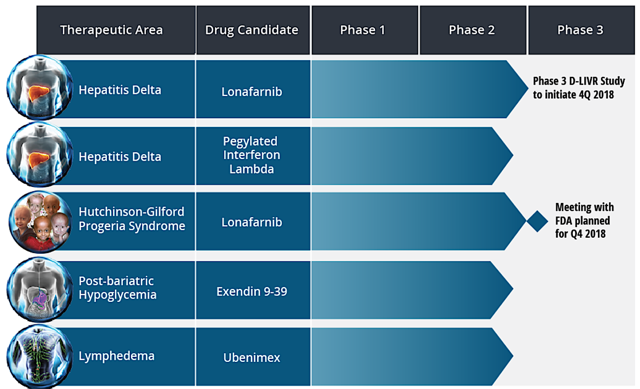
Figure 2: Therapeutic pipeline (Source: Eiger).

Known as Hutchinson-Gilford Progeria Syndrome (��HGPS��), Progeria is a rare and fatal genetic disease that manifests itself with the signs and symptoms of accelerated aging. The underlying defect is the mutation of the lamin A gene, thus creating an overproduction of a rogue protein (progerin). Without the normal enzyme made from the expression of the lamin A gene, the cell��s nucleus becomes unstable.

Consequently, this leads to a plethora of symptoms of premature aging. As follows, patients afflicted by progeria usually died from heart disease (atherosclerosis) at the median age of 14.5 years. This is interesting because other patients dying from atherosclerosis are well into their old age. That aside, other manifestations include failure-to-thrive, thickened skin, abnormal fat distribution, hair loss, joint contractures, skeletal dysplasia, and strokes. The current treatments are geared toward symptomatic relief. Due to its lethality, the demand for better treatment is quite strong. And, Lonafarnib is likely that candidate.

Lonafarnib is an interesting molecule that works by inhibiting the enzyme (farnesyltransferase) involved in the chemical process coined farnesylation: this is imperative for the tight binding of the nuclear envelope that, in and of itself, is responsible for the nuclear instability. In-licensed from Merck, Eiger interestingly does not have to pay any binding royalties. Of note, the said drug is already designated as the orphan molecule by the FDA. And, it��s been dosed in over 80 children with Progeria in various Phase 1/2 and Phase 2 studies.

On May 16, 2018, Eiger announced the expanded-licensing agreement with Merck known as MSD for Lonafarnib. The said deal enabled Eiger to expand its development and commercialization rights outside of the US and Canada for Progeria. In addition, the company disclosed the completed collaborative agreement with the Progeria Research Foundation (��PRF��).

In this relationship, Eiger will continue to provide PRF with the free supply of Lonafarnib for ongoing clinical trials and expanded access, needed for any new drug application (��NDA��) filing based on PRF data. Moreover, the company intends to meet with the FDA for the guidance re the potential filing for approval. Commenting on the key development, the Medical Director and Co-Founder of PRF (Dr. Leslie Gordon) enthused:

Our mission at PRF is to discover treatments and the cure for Progeria, and its aging-related disorders, including heart disease. In a relatively short time, we have achieved extraordinary progress towards our mission including the Progeria gene discovery in 2003, the first clinical trial in Progeria initiated in 2007, and clinical evidence of a survival benefit for children administered Lonafarnib. We are indebted to Merck for supplying Lonafarnib free of charge to PRF-supported clinical trials, and for facilitating our new partnership with Eiger. We look forward to collaborating with Eiger as we pursue pathways for regulatory approval of Lonafarnib in Progeria.

For Q1 2018 (ended on March 31), Eiger reported the $8.8M ($0.84 per share) net losses compared to $11.2 ($1.34 per share) declines for the same period a year prior. The research and development expenses decreased to $5.5M from $7.5M. Investors should be cognizant that it is the norm for a relatively young bioscience like Eiger to incur significant losses for many years prior to banking a net profit (due to the lengthy and low success rate of the innovation process). Nonetheless, it only takes one blockbuster to make your investment worthwhile.

Pertaining to the balance sheet, there were $33.2M, thereby representing a 20% decrease from the $41.8M for the similar period. Based on these metrics, the company would need to execute a financing within the next three quarters. Given the recent share price appreciation, it would be prudent for the company to raise capital via an offering soon.

Final Remarks

Eiger BioPharmaceuticals is brewing a promising portfolio of therapeutics that can deliver strong outcomes like that for the progeria franchise that we discussed. Despite its small market potential, Lonafarnib can significantly augment the value for this small-cap bioscience. That aside, other franchises can deliver more additive value. Last but not least, it��s best to add a small pilot position while waiting for a pullback to build more shares: a stock can give up significant gains subsequent to a gargantuan bull run.

Author��s Notes: We��re honored that you took the time to read our market intelligence. Founded by Dr. Hung Tran, MD, MS, CNPR, (in collaborations with Analyst Vu, and other PhDs), Integrated BioSci Investing (��IBI��) is delivering stellar returns. To name a few, Nektar, Spectrum, Atara, and Kite procured over 335%, 151%, 260%, and 83% profits, respectively. Our secret sauce is extreme due diligence with expert data analysis. The service features a once-weekly exclusive Alpha-Intelligence article, daily analysis/consulting, and model portfolios. Of note, there is an IBI version of this article that is a higher-level intelligence with extensive details, in which we published in advanced and exclusively for our subscribers. And, we invite you to subscribe to our marketplace now to lock in the current price and save money for the future.

Disclosure: I/we have no positions in any stocks mentioned, and no plans to initiate any positions within the next 72 hours.

I wrote this article myself, and it expresses my own opinions. I am not receiving compensation for it (other than from Seeking Alpha). I have no business relationship with any company whose stock is mentioned in this article.

Additional disclosure: I like to inform our readers of Seeking Alpha's recent policy change, in which the company implemented the paywall (not only to my articles but to all articles that are published over 10-day). This is in place, as the company is, after all, a business. And, the revenues from ads are not adequate to support the high-quality research that the company is providing. If you are a REAL TIME FOLLOWER, you will be notified immediately of our new research for you to continue to benefit from our due diligence. You can also gain access to all of my old articles and much more by taking the 2-week FREE trial of my marketplace, Integrated BioSci Investing.

Editor's Note: This article covers one or more stocks trading at less than $1 per share and/or with less than a $100 million market cap. Please be aware of the risks associated with these stocks.

Tuesday, May 22, 2018

GE's rail unit merges with Wabtec in $11B deal

General Electric will merge its train engine division with railroad manufacturing firm Wabtec in an $11 billion deal, a major move in GE CEO John Flannery's mission to streamline the Boston-based conglomerate.

Wabtec�Corp., based near Pittsburgh in Wilmerding, Pa., will pay GE a $2.9 billion upfront payment and Wabtec shareholders will own about 49.9% of the combined company, when the deal closes in early 2019, the companies said Monday.�GE shareholders will own about 40.2% and GE will own 9.9% of the merged company.

Originally known as Westinghouse Air Brake Technologies Corp., Wabtec is valued at $9.1 billion. The rail equipment company has�18,000 employees and generated about $3.9 billion in revenue in 2017. GE Transportation, which includes locomotives and rail services, has about�9,000 employees and�generated about $4.2�billion in revenue in 2017.

More Money: Older workers get flexible hours, work-at-home options to keep them from retirement

More Money: Why rising gas prices won't last, even after Trump ends Iran nuclear deal

More Money: Boomerang kids 101: How to handle money when your adult children move back home

��By bringing together our highly complementary strengths we are confident that this transformational combination will create value for both Wabtec and GE shareholders, innovative solutions for our customers, and new outlets for long-term career growth for our employees," said�Wabtec CEO Raymond Betler, who will serve as president and CEO of the combined company.�

"Our two companies have more than 250 years of rail industry heritage, and our shared focus on safety, reliability, quality, and customer relationships will enable a smooth integration.��

Executives did not address what effect the merger might have on jobs, but did say the merged company is expected to�generate about $250 million in annual synergies by 2022, and gain a tax benefit of about $1.1 billion.

Speculation about the deal emerged last month. Flannery, who in June succeeded former CEO Jeff Immelt, has been overseeing a comprehensive review at GE. Last year, he said the company would reduce its assets by $20 billion.

GE's transportation unit, which included locomotives, mining technology and marine engines, did not fit within the company's planned refocus, which Flannery has said� would have three core segments: power, including renewable energy, aviation and health care.

GE shares (GE) were up 2.6% to $15.36 in early trading Monday, while Wabtec (WAB) shares rose 1.7% to $96.81.

More Money: GE weighs a breakup of iconic U.S. conglomerate amid insurance problem

More Money: GE announces broad restructuring, to keep health care, aviation, and energy units

Follow USA TODAY reporter Mike Snider on Twitter: @MikeSnider.

Sunday, May 20, 2018

OGE Energy Corp. (OGE) Shares Bought by SG Americas Securities LLC

SG Americas Securities LLC increased its position in OGE Energy Corp. (NYSE:OGE) by 24.4% in the 1st quarter, according to the company in its most recent Form 13F filing with the Securities & Exchange Commission. The firm owned 54,097 shares of the utilities provider’s stock after buying an additional 10,617 shares during the quarter. SG Americas Securities LLC’s holdings in OGE Energy were worth $1,773,000 at the end of the most recent reporting period.

Several other institutional investors have also recently made changes to their positions in OGE. Millennium Management LLC lifted its holdings in shares of OGE Energy by 92.2% in the fourth quarter. Millennium Management LLC now owns 4,070,942 shares of the utilities provider’s stock valued at $133,975,000 after buying an additional 1,952,995 shares during the period. Amundi Pioneer Asset Management Inc. acquired a new stake in shares of OGE Energy in the fourth quarter valued at $47,463,000. Renaissance Technologies LLC lifted its holdings in shares of OGE Energy by 140.5% in the fourth quarter. Renaissance Technologies LLC now owns 2,189,800 shares of the utilities provider’s stock valued at $72,066,000 after buying an additional 1,279,200 shares during the period. Zimmer Partners LP lifted its holdings in shares of OGE Energy by 257.1% in the fourth quarter. Zimmer Partners LP now owns 625,000 shares of the utilities provider’s stock valued at $20,569,000 after buying an additional 450,000 shares during the period. Finally, Deutsche Bank AG lifted its holdings in shares of OGE Energy by 159.9% in the fourth quarter. Deutsche Bank AG now owns 573,416 shares of the utilities provider’s stock valued at $18,868,000 after buying an additional 352,807 shares during the period. Institutional investors and hedge funds own 62.76% of the company’s stock.

Get OGE Energy alerts:

A number of brokerages have recently issued reports on OGE. Zacks Investment Research lowered OGE Energy from a “buy” rating to a “hold” rating in a research report on Tuesday, April 17th. Guggenheim reaffirmed a “buy” rating and set a $35.00 target price on shares of OGE Energy in a research report on Friday, February 23rd. ValuEngine lowered OGE Energy from a “hold” rating to a “sell” rating in a research report on Wednesday, May 2nd. Bank of America raised OGE Energy from a “neutral” rating to a “buy” rating and set a $34.00 target price on the stock in a research report on Friday, February 23rd. Finally, UBS began coverage on OGE Energy in a research report on Friday, February 2nd. They set a “neutral” rating and a $33.00 target price on the stock. One equities research analyst has rated the stock with a sell rating, six have given a hold rating and five have given a buy rating to the company. OGE Energy presently has a consensus rating of “Hold” and a consensus target price of $36.00.

In other OGE Energy news, Director Peter D. Clarke purchased 1,850 shares of the company’s stock in a transaction that occurred on Monday, February 26th. The shares were purchased at an average cost of $32.40 per share, with a total value of $59,940.00. Following the completion of the transaction, the director now owns 1,850 shares of the company’s stock, valued at $59,940. The acquisition was disclosed in a filing with the Securities & Exchange Commission, which is accessible through this hyperlink. 0.44% of the stock is currently owned by insiders.

Shares of OGE Energy opened at $33.35 on Friday, MarketBeat reports. The firm has a market cap of $6.65 billion, a PE ratio of 16.57, a P/E/G ratio of 2.80 and a beta of 0.67. The company has a current ratio of 0.41, a quick ratio of 0.24 and a debt-to-equity ratio of 0.65. OGE Energy Corp. has a 12-month low of $29.59 and a 12-month high of $37.32.

OGE Energy (NYSE:OGE) last announced its earnings results on Thursday, May 3rd. The utilities provider reported $0.27 earnings per share (EPS) for the quarter, topping analysts’ consensus estimates of $0.17 by $0.10. The company had revenue of $492.70 million for the quarter, compared to analyst estimates of $470.69 million. OGE Energy had a return on equity of 10.87% and a net margin of 27.77%. OGE Energy’s revenue for the quarter was up 8.0% compared to the same quarter last year. During the same period in the previous year, the firm earned $0.18 earnings per share. equities research analysts predict that OGE Energy Corp. will post 2 EPS for the current fiscal year.

The firm also recently declared a quarterly dividend, which will be paid on Monday, July 30th. Investors of record on Tuesday, July 10th will be given a dividend of $0.3325 per share. This represents a $1.33 annualized dividend and a yield of 3.99%. The ex-dividend date is Monday, July 9th. OGE Energy’s payout ratio is 69.27%.

OGE Energy Company Profile

OGE Energy Corp., together with its subsidiaries, operates as an energy and energy services provider that offers physical delivery and related services for electricity and natural gas primarily in the south central United States. The company operates in two segments, Electric Utility and Natural Gas Midstream Operations.

Want to see what other hedge funds are holding OGE? Visit HoldingsChannel.com to get the latest 13F filings and insider trades for OGE Energy Corp. (NYSE:OGE).

Institutional Ownership by Quarter for OGE Energy (NYSE:OGE)